
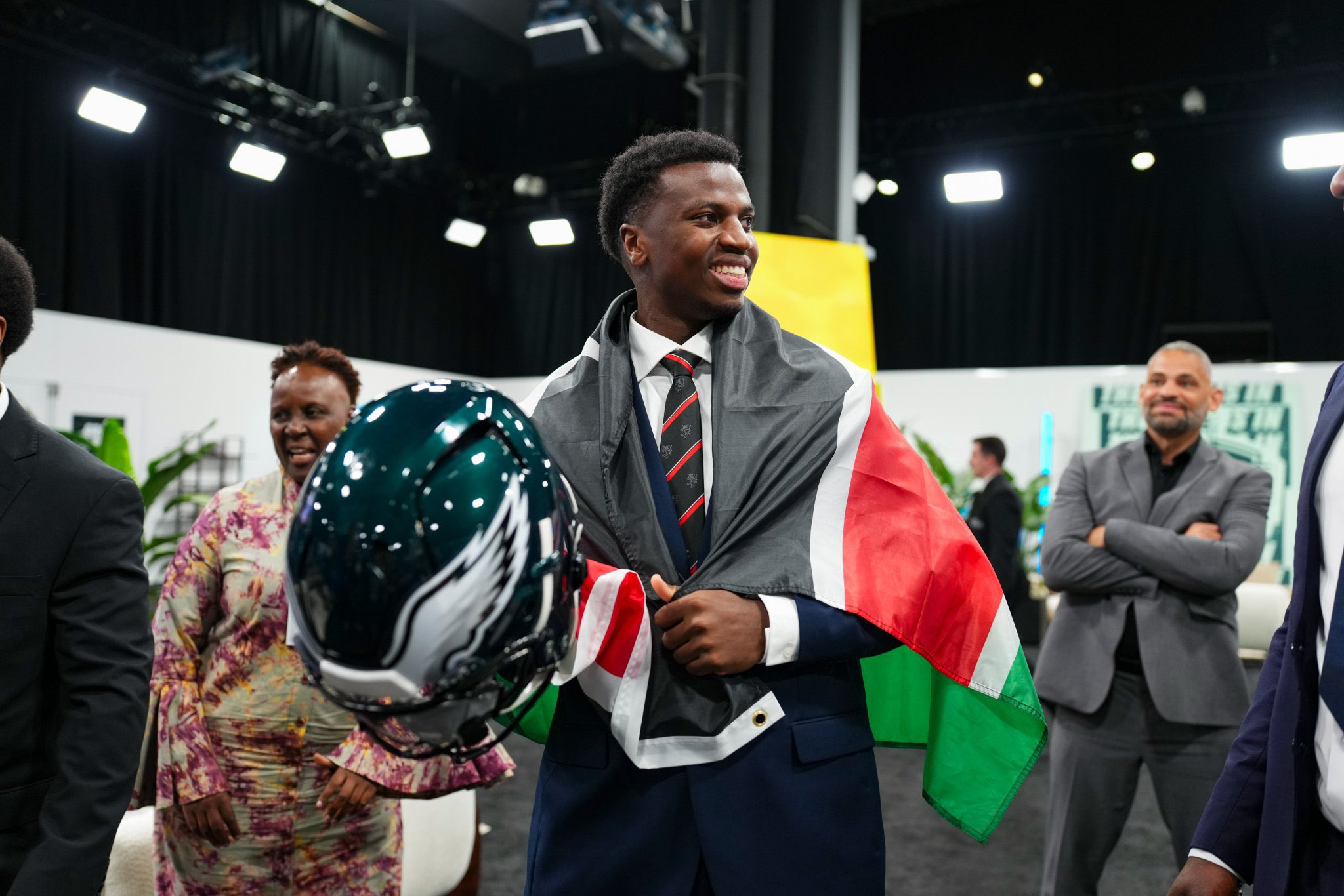
- Joshua Weru made history as the first Kenyan and East African to sign with an NFL franchise.
- The former rugby player completed a remarkable transition to American football after moving to the United States to pursue the sport.
- Despite going undrafted, Weru earned a spot with the Philadelphia Eagles through the International Player Pathway Program.
Kenyan-born star Joshua Weru has become not only the first Kenyan, but also the first East African ever to be signed by an NFL franchise.
Weru, was announced on Saturday, April 25, as one of the undrafted players set to join the Philadelphia Eagles as a free agent through the NFL International Player Pathway (IPP) Program.
Although the Eagles did not pick him in the draft, they ensured he secured a spot on their 90-man roster for the summer.
But who exactly is Joshua Weru? SportPesa Blog dives into the journey of this history-making athlete and how he climbed into the NFL ranks without being drafted.
How did Kenyan Joshua Weru make NFL history without getting drafted?
Wer u, born in Kenya in 2003, seemed destined for a rugby career, only for fate to take a different turn.
He is the son of former Kenyan international Ken “KT” Thimba, who played for the national team as well as Kenya Harlequins.
Following in his father’s footsteps, Weru took up rugby early and represented the Kenya U15 team, Kenya Chipu, during the 2023 World Cup final qualification tournament.
He also explored professional opportunities, including a potential move to a club in France, but things did not unfold as he had hoped.

At age 14, he relocated to the United Kingdom for high school attending Stowe School.
Later, he transferred from Stowe to Rugby School, where he trained and played rugby while completing his A-levels in the UK.
Weru’s rugby career gained momentum when he joined the Northampton Saints academy system, following his scouting at Stowe School.
While in the club’s youth setup for the under-18s, Weru mostly featured at No. 8 or blindside flanker, thanks to his power and speed.

He signed his first professional contract with Northampton Saints, moving up from the Under-18s into the senior academy setup in 2022.
Signing that deal made Weru the ninth player from that Under-18 group to ascend. He was set to train with the first-team squad at Franklin’s Gardens while studying full-time for a degree at Loughborough University.
But throughout that period, his mind kept drifting toward American football. While still training and waiting for his next opportunity, those thoughts kept circling back to the gridiron.
Although he had always considered the switch, his main focus had previously been rugby.

Eventually, he decided to pursue American football more seriously, which led him to move to the United States and enroll at Arizona State University.
At first, he hoped to be quickly picked up by the university’s football team, but that chance did not come right away.
However, he was later contacted by an IPP scout named Mark, who offered him a workout. After performing well, he earned a tryout in Loughborough, England.
ALSO READ: Donald Trump names his football GOAT: Who did he pick?
His efforts paid off, and he secured a spot in the IPP program in Florida, got the opportunity to play intramural flag football at ASJ, and also completed four weeks of combined training at Exos in August 2025.
Now, the former Kenyan rugby player brings ridiculous athletic testing numbers for his size. The 6′4″, 244-pound linebacker posted a 4.45-second 40-yard dash, a 41.5-inch vertical jump, and an 11-foot broad jump.
After a 10-week training camp and a showcase performance that left every scout buzzing, he is now a Philadelphia Eagle, joining the NFL in a historic move where he is bound to make waves.
On top of making history, the 21-year-old is also set to earn a solid income. NFL undrafted free agents typically sign three-year contracts with league-minimum salaries each season.
In 2026, the minimum salary stands at $885,000(approximately Ksh. 114,377,400), rising to $930,000 in 2027 for players entering the league through this route.
Rookies selected after the third round earn similar base salaries, though their contracts usually span four years instead of three.