
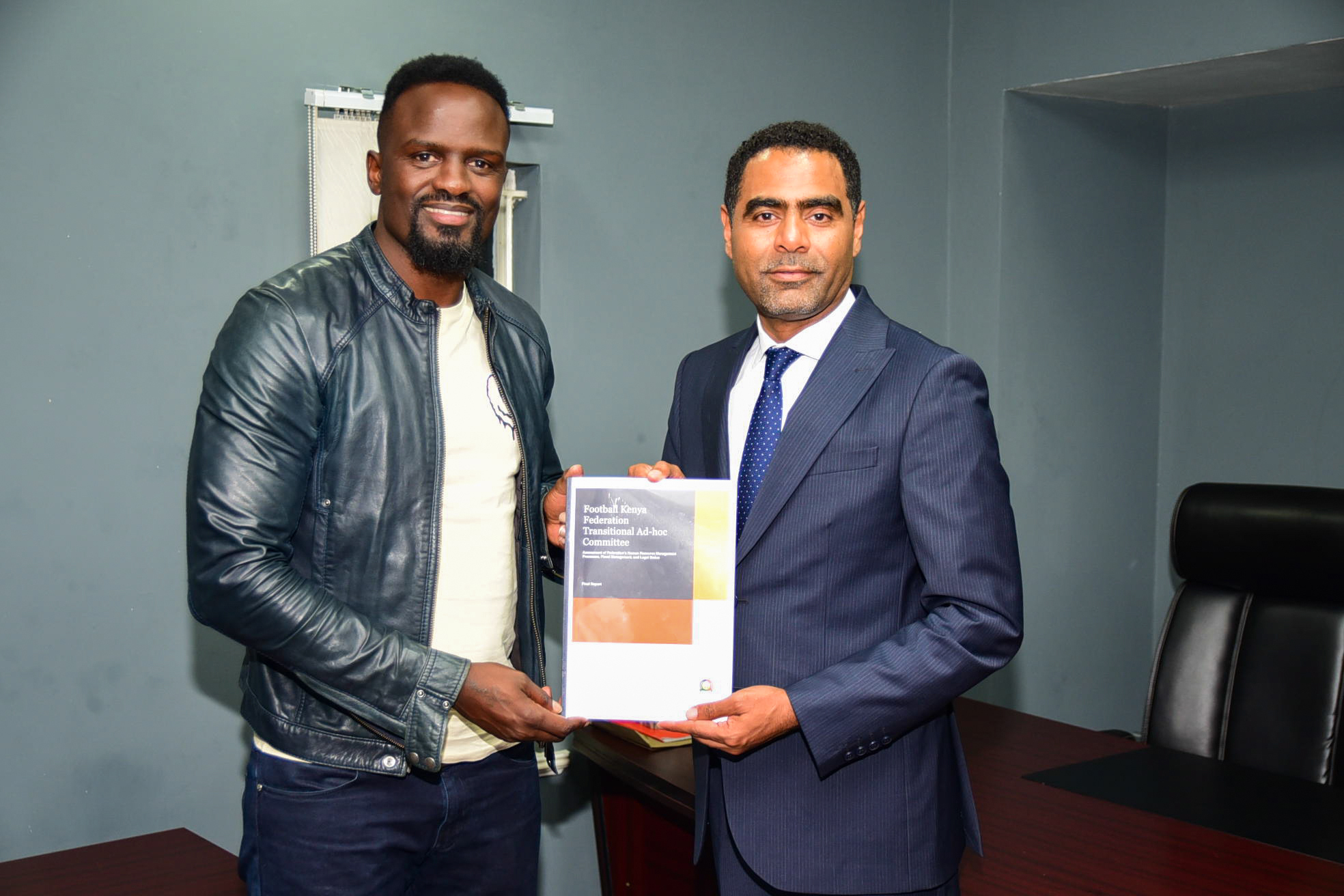
The Football Kenya Federation (FKF) faces financial risk following a recent report indicating that the body is dealing with a debt of Kshs. 383,940,846 left by the previous regime led by Nick Mwendwa.
Th is according to an audit conducted by a seven-member FKF Transition Ad Hoc Committee chaired by FKF Vice President McDonald Mariga.
The committee performed a comprehensive review of FKF’s governance structures, financial management, human resources and legal framework as they identified key areas for reform.
Presenting the report on Wednesday at Weston Hotel in Nairobi, FKF President Hussein Mohammed stated that, as of December 31, 2024, in addition to the millions in debts, FKF was operating with 16 bank accounts with no clear purposes and lacked transparency.
“The financial situation of FKF is precarious, with several alarming issues identified:
- Excessive Bank Accounts: FKF operates 16 bank accounts, with unclear purposes and a lack of transparency.
- Outstanding Liabilities: As of December 31, 2024, FKF’s outstanding payables amount to KES 383,940,846.70. This includes debts to external agencies and service providers, which pose a significant financial risk to the Federation,” the report stated.
In addition to the financial concerns, the report also highlighted unequal funding among women’s, youth, and men’s football.
“There is a marked disparity in the funding allocated to women’s, youth, and men’s football, with men’s football receiving the bulk of funding, leaving women’s and youth football underfunded,” the report explainedd.
Play here and stand a chance of winning the over 401 Million SportPesa Mega Jackpot
To address these issues, the committee recommended consolidating FKF’s bank accounts, restructuring its debts, conducting a thorough forensic audit, and increasing funding for women’s and youth football to ensure equitable development.
The committee also found that FKF does not have an approved Human Resources policies and procedures manual, which has led to inconsistencies and inefficiencies in recruitment, employment contracts, and payroll management.
ALSO READ: CAF announces draw date for 24/25 CAF Champions League and Confederation Cup quarterfinals
There was also a disturbing pattern of potential fraud and irregular recruitment pactices, where employment contracts were found to lack basic security features and were irregularly signed, raising concerns over their authenticity.
Furthermore, there is no defined salary grading system, causing pay inconsistencies and dissatisfaction among employees.
The committee recommended a full forensic audit to verify the authenticity of contracts, an overhaul of HR policies, and the introduction of a standardized salary grading system.
The report also called for the establishment of clear merit-based promotion policies for referees, a comprehensive code of conduct, and an enhanced focus on training and capacity-building to improve professionalism.
ALSO READ: Harambee Starlets name provisional squad for WAFCON 2026 qualifier
Additionally, the committee emphasized the need to initiate a legislative process to address match-fixing in the long term.
This should include clear legal frameworks, severe penalties for offenders, and a dedicated legal committee to oversee this effort. Collaboration with law enforcement agencies will be critical in addressing these issues.
The detailed report will be presented to the National Executive Committee (NEC) for validation and publication. The committee’s recommendations will offer a clear path forward.
