
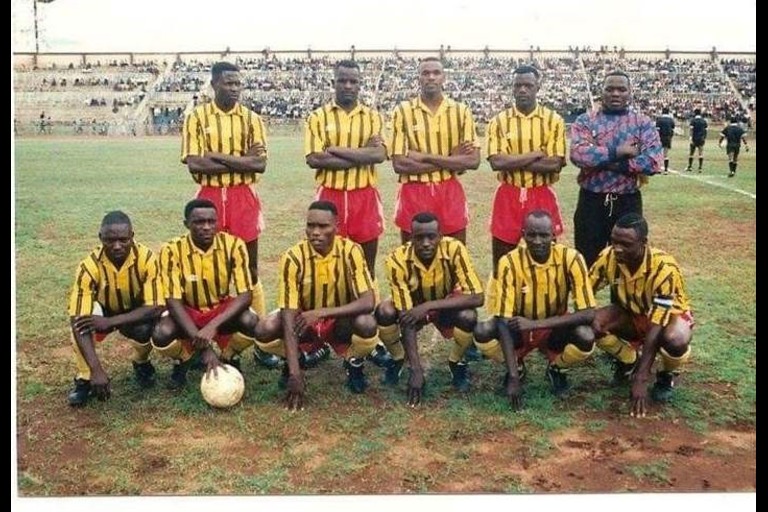
A glittering gaze in the lobby
The thought struck me within seconds of entering the offices of Tusker Football Club at the club’s training ground in Ruaraka. I came face to face with the club’s trophy cabinets which have white LED strip lights snaking along their outer edges. That shimmering outline reflected on the cabinets’ residents, plaques and trophies of all shapes and sizes that returned a glittering gaze.
In that moment, I thought to myself, “If all had gone well 30 years ago, the 1994 African Cup Winners’ Cup trophy would have been part of this glowing collection of Tusker FC’s success on the football field.”
In 1993, Tusker FC, then known as Kenya Breweries FC, won the Moi Golden Cup and as a result earned the right to represent Kenya in the 1994 African Cup Winners’ Cup, a competition which Gor Mahia had won in 1987 after overcoming Tunisia’s Esperance de Tunis.
The following year, Kenya Breweries’ quest to emulate Gor Mahia as the only East African football club to win a continental trophy started with a 5-1 aggregate walloping of Mozambique’s Ferroviario da Beira in the First Round.
With Rwanda’s Rayon Sports withdrawing from the competition before their Second Round meeting, Kenya Breweries were awarded a walkover victory and progressed to the quarterfinals where they eliminated Reunion’s US Stade Tamponnaise after defeating them 2-1 on aggregate.
In their semi-final contest against Mbilinga of Gabon, the rains came to Kenya Breweries’ rescue as Henry Motego’s hat-trick in the second leg played at the Nyayo National Stadium ensured they won the tie 4-1 on aggregate.
Unbeaten throughout the tournament, Kenya Breweries had one hand on the trophy after managing a 2-2 draw away to Zaire’s Daring Club Motema Pembe on November 27, 1994. With two away goals, Kenya Breweries needed only a 0-0 or 1-1 draw in the return leg to secure an eternal place in the history of African football.
However, what followed was the most dumbfounding capitulation in the history of Kenyan club football. On December 10, 1994, at a packed Nyayo National Stadium, Kenya Breweries lost 3-0 and scenes from that horrifying afternoon remain the last time a Kenyan football team featured in the final of a continental competition.

Brewer for life
After snapping out of my enamouring of Tusker FC’s trophy cabinet, I freed myself from that wistful solitary confinement in the lobby of Tusker FC’s offices and I made my way to an adjoining room where I met George Opondo, Tusker FC’s bespectacled tall and lean team manager.
Opondo has been Tusker FC’s team manager since 2016 but his history with the club is longer than that and it transcends his life.
“I was born here. My father worked for the Kenya Breweries and we lived in the house adjoined to this office. Charles Obiny’s (a former CEO of Tusker FC) office used to be my bedroom,” Opondo, 61, tells me of his long association with the Kenya Breweries.

His history with the team, however, started in 1985, or thereabouts, he says as he shakes an open palm close to his face. “A lot of people know me as Tusker FC through and through, but there is a lot of historical information about the club I am yet to acquaint with,” Opondo adds on his struggles to recall certain periods in the club’s history, including some that he was heavily involved in.
However, those lapses in memory do not show up as we speak about Kenya Breweries’ humiliating defeat to Daring Club Motema Pembe 30 years ago. He has vivid recollection of almost every detail and his narration of the events that took place during their two-legged encounter against the Zaireans matched what Henry Motego, Jacob “Ghost” Mulee, Sammy “Pamzo” Omollo, Sammy Sholei, and Shem Nyaberi told me in conversations we had about that match 8-10 years ago when I interviewed them for stories I wrote for the Radio Jambo website.
Joseph Kibera is out
If anything, the last match Kenya Breweries played before leaving for Kinshasa had foreshadowed the manner in which they later succumbed to Motema Pembe.
Playing against Scarlet in a Kenyan National Football League match at Ruaraka, Kenya Breweries threw away a three-goal lead to lose 4-3 to the military side.
“We were leading 3-0 but they came back and beat us 4-3. It happened right here,” Opondo says as he insistently pointed in the direction of the football pitch.
That defeat to Scarlet had Kenya Breweries doubting their ability to prevail against Motema Pembe. Also, the players lost confidence in their second-choice goalkeeper, Charles Bwire Namudeche, whom they blamed for the four goals they conceded against the soldiers.
Namudeche was standing in for the late Joseph Kibera who was out with a chest infection. Despite his condition, the club included him in the squad that travelled to Zaire with the hope that his health would improve before matchday.
“When we arrived in Zaire, Kibera’s condition got worse. He could not even train and as such, Elly Adero was in a dilemma on whom to pick between Namudeche and Jacob “Ghost” Mulee,” Opondo says.
Namudeche to the rescue
With Kibera out, Adero, as the players later discovered when they exchanged notes before the match, consulted each player individually on whom between Mulee and Namudeche he should pick to start in goal. Despite what had happened in the match against Scarlet, the players showed overwhelming confidence in Namudeche.
With Elly Adero picking his starting goalkeeper after employing a style of leadership – democracy – that was alien in Mobutu Sese Seko’s Zaire, as the Democratic Republic of Congo was known then, Namudeche redeemed himself in style in the match played at the Stade de Kamanyola, an 80 000-capacity stadium which had been inaugurated in September of that year.
“Namudeche played the game of his life. He even saved a penalty,” Opondo says with excitement.
The team was also thrown into a state of panic on the eve of the match as dependable centre-back, Sammy “Pamzo” Omollo went down with malaria.
As recounted by Sammy Sholei when I to spoke to him about the match 10 years ago, “We do not know what our team doctor, Wycliffe Makanga, did but he treated Omollo the whole night and in the morning, Omollo was fit to play.”
Sholei did not play in that match, and the return leg, as he was carrying an ankle injury but Omollo, after Makanga conjured some medical miracle to restore his fitness, put in a man-of-the-match performance as the late Patrick Nachok’s 5th minute opener and Henry Motego’s 55th minute equalizer sandwiched Motema Pembe’s two goals in that 2-2 draw.
“Omollo was our best player that day,” Opondo says with his hand covering his mouth, evoking the freshness of his shock of Omollo’s recovery and his performance on that day.
The performance was more than what Kenya Breweries had bargained for. As Opondo recalled, Kenya Breweries had travelled to Kinshasa with mixed emotions. Their goalkeeping crisis and the defeat against hanged over them but still they were excited at having reached a major final.
“For us, reaching that final was already an achievement. By our estimation, we did not expect to go that far because the team we eliminated in the semi-final (Mbilinga of Gabon) was the most formidable team in that competition. They were at a higher level than us.”
Against Mbilinga, Kenya Breweries had managed a 1-1 draw in Gabon but in the return leg, played in Nairobi at Nyayo, the rain played to the brewers’ advantage as Henry Motego produced the finest moment of his playing career. Motego, nicknamed “The Elephant” like the ubiquitous pachyderm that is the face of Tusker beer, scored a hat-trick to see Kenya Breweries progress to the final with a 4-1 aggregate victory over the central Africans.
“I noticed that the Gabonese were not adept at playing in the rain. They exhibited weakness which I took advantage of to score thrice,” Motego told me in December 2014.
Big in Kinshasa
With an economy struggling under the dictatorial rule of Mobutu Sese Seko, Zaire was not a place many dreamed of visiting in 1994. In fact, during my conversation with Sholei in December 2014, he termed the Zaire of that time being close to Sierra Leone as the worst country he had ever visited.
Due to the poor state of security in Zaire at the time, soldiers drawn from Zaire’s military were assigned to protect Opondo and his teammates.
Despite their host’s concern over their security, the Kenya Breweries delegation, according to Opondo felt safe mingling with the locals and after the match, in celebration, they let loose in their immersion of Zairean culture and night life.
Of particular interest to the players, who had become accustomed to Lingala music, a Zairean product that rivalled their mineral deposits as the country’s best export, was moving from hotel to hotel attending shows by the biggest Zairean musicians of the time.
“There were performances everywhere and we attended shows by Koffi Olomide and Madilu System. They used to perform in hotels and tickets went for just one dollar (equivalent to KES 45 at the time), way cheaper than the couple of hundreds we used to pay when we attended their shows in Nairobi,” Opondo says.
As Opondo also recalled, the players also ended up being back-up dancers for Nyboma Modindo when he was shooting a video for one of his songs at the hotel they were staying in.
“There are some Modindo songs we appear in dancing in the background. The crew did not mind us joining them as they shot the video,” he says with a laugh.
That dabbling in Congolese night life also included a familiarisation with Zairean beer brands – Primus and Skol. To their pleasant surprise, the players discovered that in Zaire, beer was sold in one-litre bottles, and in their revelling, they left their hosts stunned.
“Unknown to us, the Zaireans were used to a one-litre bottle of beer serving four people and they were shocked when they saw each Kenyan ordering two one-litre bottles,” Opondo says before breaking into a laugh.
This experiencing of Congolese culture also extended to their exotic cuisine as Jacob “Ghost” Mulee, during one conversation I had with him in April 2015, admitted to having eaten monkey meat while in Kinshasa at that time. “I am not afraid to try new food. I try it once and if I like, I try it twice,” the former Harambee Stars coach said of his exotic palate.
The old man at the airport in Kinshasa
Before they boarded their flight back to Nairobi, an old man they found at the airport in Kinshasa summoned Ghost Mulee for a brief chat in which he passed an ominous message to the goalkeeper.
“Ghost understands French and after speaking with that old man, he came back and told us that he had said to him that Motema Pembe never plays well at home but in Nairobi they will beat us 3-0,” Opondo says calmly in a low voice before adding that Ghost used to be his roommate whenever they were in camp.
The old man was probably playing mind games as, looking at the Zairean club’s record in that competition that year, Motema Pembe had lost thrice and drawn once in four away matches.
Kenya Breweries, on the other hand, had won all their three home matches without conceding a goal. If anything, the match was Kenya Breweries’ to lose but that old man’s words came to haunt them after they capitulated in Nairobi.
Save your dollars for Johannesburg
On the plane back to Nairobi, Kenya Breweries’ chairman Frank Owino was in a jovial mood. Pleased with his team’s performance in Kinshasa and confident of their victory in the return leg, he advised the players not to spend their money on the duty-free items being sold in plane.
“Save your dollars for Johannesburg,” Opondo remembers him shouting to the players at every opportunity.
“If he found you trying to buy anything, he would tell you, ‘Let me buy that for you. Save your dollars for Johannesburg.’ He spoiled us.”
The South African city was scheduled to host the 1994 CAF Super Cup in January 1995 and, clearly, Owino, in his mind, had seen his team contesting that match against the winner of the 1994 CAF Champions’ Cup, now the CAF Champions League. [PS: A check later revealed that 1994 CAF Super Cup was played in January 1995 in Alexandria, Egypt, where Motema Pembe lost 3-0 to Esperance de Tunis. However, Johannesburg hosted the CAF Super Cup in 1994 and 1996].
The mention of Owino had Opondo reminiscing on the club’s leadership at that time. “They gave us the best support. In 1994, most of us rarely reported to work at the company. We were even in camp preparing for a match or travelling within and outside the country.”
That year, Kenya Breweries almost won it all. They were on course for a historic treble. Quadruple if you count the CAF Super Cup. In the league, they broke the 15-year AFC Leopards-Gor Mahia duopoly as the Brewers won their first league title since 1978. A 2-0 semi-final loss to AFC Leopards stopped Kenya Breweries from defending their Moi Golden Cup title.

A heroes’ welcome
Kenya Breweries were received to a heroes’ welcome when they arrived in Nairobi and were treated like kings until they played Motema Pembe.
“We were showered with gifts and praise everywhere we went. I remember an Indian shop owner giving me a watch for free. ‘Keep that George. Make sure the cup stays home,’ he said to me. The mood everywhere was that we had already that won that match,” Opondo says.
Sholei’s recollection when I spoke with him 10 years ago was even more amusing as he recalled the team being treated to parties, haircuts and spa treatments at executive barbershops, and being given new suits from a popular Indian shop known as Mandalia.
“The night before the game we even went out as a team to watch movie at a cinema,” Sholei said.
Omollo, on the other hand, recalled that moment as the team having a premature arrival in the Promised Land. “We were already in Canaan even before playing the game,” he said.
They entered the hotel, peed and asked to leave
Kenya Breweries’, as Opondo regretfully recalled, got carried away with counting their chicks before they hatched that they paid no interest to Motema Pembe’s arrival in the country.
“We dropped our guard,” Opondo says with a regretful tone. “We also disrespected them somehow by booking them a hotel in downtown Nairobi, at the Moi Avenue-Haile Selassie roundabout. The person we assigned to chaperone them also did not bother to assess them properly because we later found out that Motema Pembe sent a decoy team in its advance delegation. The team comprised their fringe players and some of their fans. Our chaperone failed to notice that. The real team arrived in a chartered flight late on Friday night and went straight to Safari Park Hotel without our knowledge.”
When we spoke in December 2014, Mulee shared a hilarious recollection of that decoy team. “When they arrived at the hotel we had booked for them, they asked to be shown the toilets and after peeing, they asked to be taken to a better hotel. When they were taken to another hotel, they found a Lingala band playing and they joined them in singing and dancing. Those were not footballers.”
A meeting with CECAFA officials at Milimani Hotel
As they prepared for the return leg, Kenya Breweries operated from Milimani Hotel, situated along what is now Jakaya Kikwete Road.
A few days before the match, some CECAFA officials held a meeting there and as such got an opportunity to interact with the players.
The officials insisted on them significance of their victory to East African football and wished them luck.
One official, from the Tanzanian Football Federation, cautioned the Kenya Breweries players against repeating Simba SC’s mistake the year before.
“The Tanzanian official reminded us that in 1993 Simba were in the same position as us when they met Stella Club d’Adjame of Ivory Coast in the final of CAF Cup. Simba had drawn 0-0 away only to lose 2-0 in the return leg in Dar es Salaam. ‘Simba paid for being overconfident,’ the official told us,” Opondo says as he clasps his hands.
Unfortunately, Kenya Breweries went on to repeat Simba SC’s mistake as a tragedy and after them, no East African reached a continental final until Yanga in 2023 when they competed in the CAF Confederation Cup final.
The return of Joseph Kibera
Kenya Breweries were a tightly-knit squad but that bond between Opondo and his teammates was severely tested on day of the return leg.
“We did a lot of things together. Like going for haircuts, an activity that Joseph Kibera introduced in the squad and gave it the name “nyoa nyoa”. We had our off days on Tuesdays and on that day we would all go out together and spend time at a restaurant with other friends,” Opondo says.
However, the players lacked that unity when they needed it most, on the day of the return leg against Motema Pembe. As Opondo and some of his teammates later found out, some players influenced the coach to start Joseph Kibera despite him not having made a full recovery.
His return to the starting line-up shocked even Sholei, who used to be his roommate found the decision shocking. “Kibera and I used to be roommates when we were in camp and I could tell he was still struggling,” Sholei said when I interviewed him in December 2014.
In an interview with the Daily Nation in 2007, Henry Motego admitted that the inclusion on Kibera killed the morale in the team as most players felt Namudeche deserved to keep his place after his performance in Kinshasa.
Opondo, on his part, reckoned that the significance of the occasion must have sparked a strong yearning in Kibera to be part of the team on that Saturday afternoon.
“The occasion must have given Kibera a strong itch to be part of the team. I mean, we were playing a continental final at home, the first in the history of our club, and if things had gone well, Kibera would forever have been associated with that moment,” Opondo says.
The team was to be further divided after settling in their dressing room before kick-off. The players started allocating medals based on the number of matches each had played before the final.
“There were players who had joined the team late or were not regular starters but were in the final squad due to regular starters being out with injury. As such, those who were set to play the game without having played a big role in previous games were asked to surrender their medals to those who had featured in more games. That being the case, the players who were asked to surrender their medals after the game lost the motivation to give their best. After all, what was the point of earning medal only to give it to someone else?” Opondo says with a shrug.
Despite the events of that day, the players have maintained their closeness in the present. They have a WhatsApp group where they keep in touch with each other. The recent passing of Austin Oduor brought them together in raising funds for his burial and funeral arrangements.
“The group is active,” Opondo says to me while scrolling the group’s timeline as more messages stream in.
The capitulation
“On December 10, you could not see a concrete slab at Nyayo. The stadium was so packed that fans were allowed to sit within the inside perimeter. It was the first time I was seeing that at Nyayo,” Opondo says of the attendance at the Nyayo National on that day.
The Kenya Breweries players had also been given complimentary tickets which they passed on to family and friends who, like the whole country, were eager to see the team make history. On top of it all, with Jamhuri Day falling on a Monday, Kenyans were set for a long weekend that would have been properly savoured celebrating Kenya Breweries’ win.
However, it was not to be. Motema Pembe ran rings around Kenya Breweries that the cartoonist Maddo caricatured the team’s woes in a pursuant issue of It’s a Madd World.
“We only won that match in our minds. What happened at Nyayo left us stunned and weak. Motema Pembe players were in tears because they could not believe they had pulled off such a win but us, we even lacked the strength to cry our sorrows away,” Opondo said as described the scenes after the final whistle on that day.
Opondo, who started the match on the bench, shared vivid recollections of the goals they let in that Saturday afternoon.
The first goal, scored by Matudidi Bamba, was a header from a corner. The ball went in off the far post and a jubilant Bamba celebrated in front of the Kenya Breweries bench.
“It was a fortuitous goal. Nine out of ten times that ball would not have gone in. That goal threw us off balance. We panicked and it was downhill for us from there,” Opondo says.
The second goal was scored by Monka Ngalama. He pounced on a loose ball from 30 yards and struck the ball on the bounce. The ball rocketed into the net as Kibera watched helplessly.
Despite Kenya Breweries later introducing Opondo and Henry Motego, the Brewers could not find a way past Mpia Kasongo in Motema Pembe’s goal.
In the dying minutes, Kapela Mbiyavanga sealed victory with a well-taken freekick. He chipped the ball over the wall and it evaded a desperate dive from Kibera as it nestled in the bottom right corner.
“Fans had started leaving before Motema Pembe scored their third goal which was greeted by fans who had remained with loud anguish. Fans who had left the stadium, including my late brother, quickly returned thinking we scored only to find we had conceded a third goal. It was humiliating,” Opondo says.
The party at The Stanley
Before the match, the club had organised a victory party at The Stanley Hotel along Kimathi Street. It turned out to be a low key event which players forced themselves to attend.
“We had no choice but to be at the party despite what had happened. We were Kenya Breweries employees and with the top leadership of the company expected to attend the party, we could not risk missing it. We attended it but our spirits were very low,” Opondo says.
The photos on the wall
When I spoke with Sammy “Pamzo” Omollo about that match in December 2014, I asked him what he remembers about the following day – December 11, 1994. “I cannot remember it all,” he replied. Opondo too said the same when I asked him as our interview drew to a close.
On the way out, photos pinned on the walls in the lobby of the Tusker FC offices held me hostage in nostalgia. On the left, photos of the team’s current squad are pinned facing frames confining images taken during trophy celebrations and squad photos of teams that achieved greatness. Even in their stillness, the current players are always reminded of the legacy they carry and the history they should always strive to create at the club. A repeat of Motema Pembe is not part of it.