
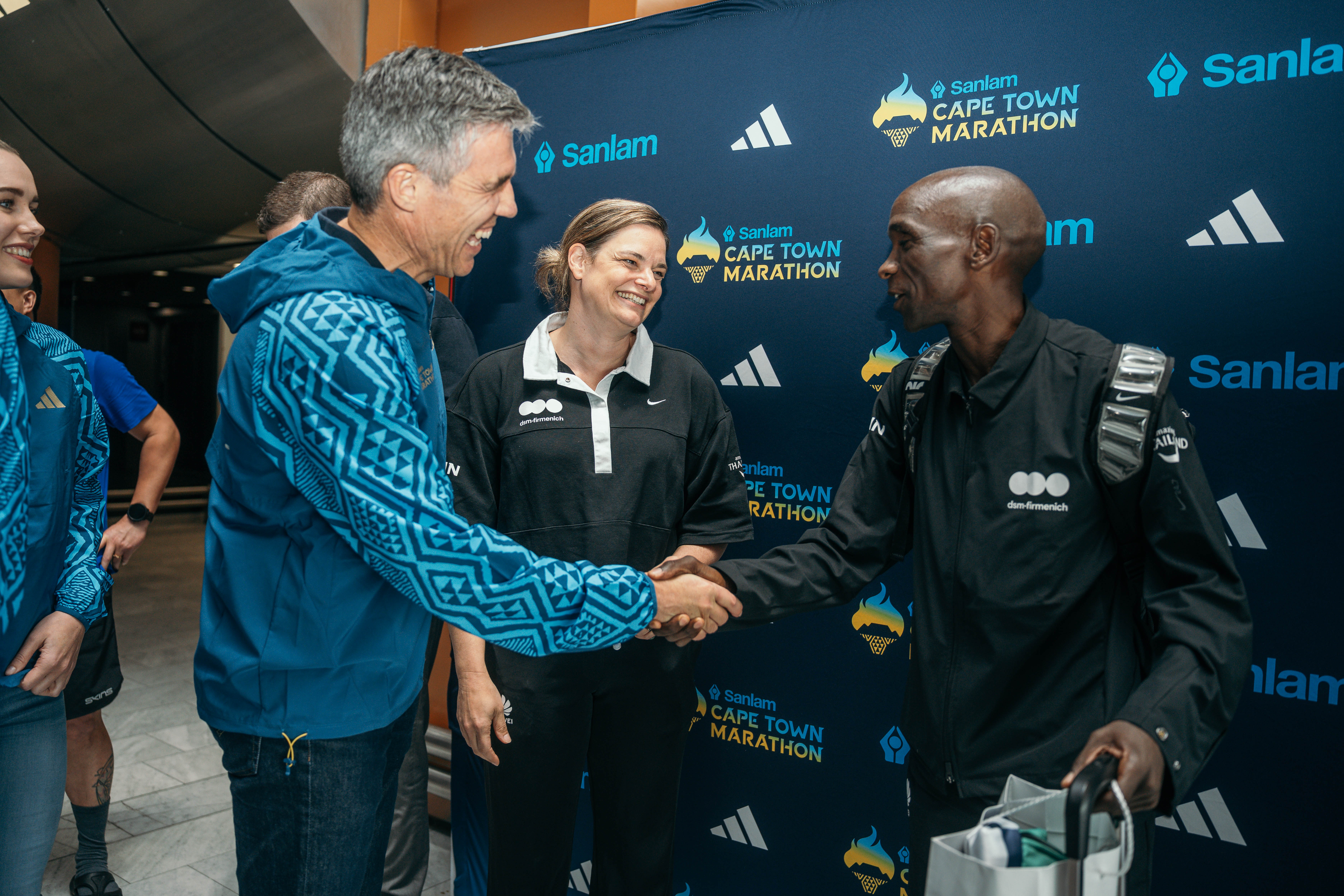
“The journey to an Abbott World Marathon Majors has been tough, but in Africa, nothing’s easy and we know that smooth seas don’t make good sailors,” Clarke Gardner, Chief Executive Officer of the Cape Town Marathon, opens up to SportPesa News.
It is only two days before the 2026 edition of the event takes place in Cape Town, South Africa on 24 May that he opens up in an exclusive interview.
And having been painfully cancelled in 2025 due to severe overnight winds that damaged vital race infrastructure and forced last-minute cancellation, the 32nd edition comes not only with a desire to make up for the disappointment but also with hope of making history in the athletic world.
As a candidate race in the Abbott World Marathon Majors evaluation process, the Cape Town Marathon could become the first race from the African continent to join the prestigious list of the great road races that take place in Berlin, London, Boston, Chicago, Sydney, New York and Tokyo.

In 2024, the majors candidate successfully passed Phase 1 of evaluation and postponement in 2025, where Phase 2 was to be conducted, meant that the continent’s historic dreams also had to be pushed.
But having gained experience towards making the Cape Town Marathon the first African Major over the last six years, Gardner is confident that, with the organization put in place for 2026, it could only be a matter of time before history is achieved.
“Fortunately, it’s only been 7 months since the cancellation and disappointment of last year, but we’ve really got all stops now to lift this race, not only to put on another one, but to put on a much better race than we even had last year.
The journey to an Abbott World Marathon Majors has been tough, but in Africa, nothing’s easy, and we know that smooth seas don’t make good sailors, and I think we’ve got about our way the last five, six years on this journey, and learned every year, progressively got better. And I think now it’s time and we’ve earned the right to be a major.
So I’m looking forward and maybe just relieved after this year if we manage to succeed,” he remarked.
ALSO READ: Eliud Kipchoge to run with wife for the first time ever in Cape Town Marathon 2026
The challenge of meeting World Major standards
In Phase 2, the Cape Town Marathon, which was confirmed as an Abbott World Marathon Majors candidate race in August 2021, has to meet stringent criteria encompassing upto 104 points across all facets of the event, a challenge Gardner reveals has been a huge mountain to conquer as a third world country.
The majors candidate evaluation requires races to meet stringent operational and logistical excellence, elite and wheelchair fields, seamless participant experience, robust safety and medical protocol and broadcast capabilities among other things.
“There’s 104 criteria we have to pass, things like no parked cars en route, an elite quality field, prize money, wheelchairs. So it’s really making sure it’s a quality race, which is quite difficult, because those are first world criteria when we live in a third world continent and country.
And you need your whole ecosystem to improve in quality in order to get to that kind of level. So we had to really smash barriers, and lift quality standards, and perfection, and intensity, in order to pass those 104 criteria, which is stage two this year and then we are an Abbott World Marathon Majors. So we’re almost there,” he said.

Cape Town Marathon honours Africa’s marathon greats
For Gardner, getting over the line in making the cape Town Marathon to be a major would not be just about the future that lies in store.
For him, the journey to getting to the top would be an honour to the previous generation of African athletes who paved the way for the continent on the global scale.
“I think the first thing is we’re honoring those magical performances of the African elites and marathon runners of the last 20, 30 years. They showed us and inspired us what is possible, and now we have our own event, because of them, because of their performances,” he said.
The impact of having a major in an African continent is also not lost on Gardner who cannot measure how the next generation will benefit.
“And what will that do in inspiring the next generation of runners? Now we’ve got kids, 250,000 on the streets on Sunday, watching the greatest ever (Eliud Kipchoge from kenya), watching Lonah Salpeter (Israel), watching Edna Kiplagat(Kenya), watching Dera Dida(Ethiopia).
And they’re gonna see what’s possible. We’re gonna be a symbol of hope. Not only just for the runners, but for the kids and the spectators that are watching in their own lives and their own dreams,” Gardner noted.

More than a race, an engine for jobs
Away from the event, Gardner is confident the race can play a major part in boosting the tourism sector in South Africa which can in turn create employment opportunities for the locals as over 44,000 participants are set to take part in the event, making it one of the largest running events on the African continent.
South Africa’s official unemployment rate stands at 32.7% according to data from the Statistics South Africa.
“I think being a major is one element, and the other element is it becomes an economic engine of attracting tourists. We’re a country with 13 million unemployed people. We need industry to succeed, such as tourism, in order to give people jobs,” he said.
READ MORE: Marathon great Eliud Kipchoge set for first-ever marathon race on African soil in Cape Town
In the journey towards Africa’s first major, Gardner was quick to heap praise on the athletes helped in convincing the Abbott World Marathon Majors that Africa deserves to be included on the list.
“I’m gonna pass it out to these incredible elite marathon runners. When I lobbied to become a candidate, I said to Abbot World Marathon Majors people, ‘we’ve got 80% of the top 50 lead runners in the world coming from Africa, and they’ve got to leave their country.
They’ve got to leave their continent in order to race because you haven’t given them a major on African continent’. My gratitude is to people like Eliud Kipchoge, Edna Kiplagat, Paul Tergat, Haile Gebrselassie. These are the greats that enabled us, one to dream big, but two, to show African excellence,” he said.
‘Crucified by disappointment’: The hardest part of it all
While the end seems near for Gardner and the large team behind the scenes, the CEO was quick to point out that it was not smooth sailing at all especially with the perfection required.
The wrath that came from the 2025 participants, due to the event’s cancellation, is also one dark moment for him.
“The hardest part has been to scale the business with a team of good people that buy into eventing and have all the energy to work all night. Another was definitely the cancellation and disappointing 24,000 people. When you expected a reward and then you get crucified by all those that were so disappointed, they couldn’t control their emotions. That was hard.
The third was in getting the city, getting the service providers, getting everyone in their inventing industry to raise their standards that will allow us to pass stage 2 and become an Abbott World Marathon Majors.
But when they manage to get over the line, Gardner will be the most fulfilled man.
“I think for now it might just be relief (when Cape Town Marathon becomes a major), but over time, it will be a deep sense of satisfaction,” he concluded.

By the numbers: over 40,000 runners, one historic weekend
With a world-class elite field that includes 13 men and eight women who have run faster than the current course records of the Cape Town Marathon, the 2026 edition of the race is set to be the fastest ever.
The 32nd edition of the race takes place on Sunday 24 May, once again starting and finishing in Green Point, and the elite athletes will be racing not only for line honours and records, but also a share of the considerably increased prize purse.
The 2026 edition of the race will see 27,000 marathon runners lining up, including a field of world-class elite runners and wheelchair athletes.
A further 17,500 will take part in the accompanying 10km and 5km Peace Runs, as well as the Cape Town Trail Marathon, 22km and 11km trail runs, which take place on Saturday, 23 May.
That means a combined field of 44,500 participants, making this one of the largest running events on the African continent.
The stacked men’s elite field includes eight athletes who have run a 2:05 marathon or faster, including Eliud Kipchoge, the former two-time World Record-holder, two-time Olympic Marathon champion and winner of 17 international marathons.
The current men’s course record is 2:08:16, set by Ethiopia’s Abdisa Tola in 2024, and 13 men in the field have run faster than that in their careers, with 10 of them having done so in the last year.
The women’s course record is 2:22:22, run by South Africa’s Glenrose Xaba in 2024, which set not only a new South African record, but was also the fastest women’s time run on African soil.
In the 2026 women’s elite field, five athletes have run faster than 2:20 and another three have clocked a 2:20 time, while four of those athletes have gone faster than the current course record in the past year.
The men’s field includes three World Athletics Platinum Label and six Gold Label athletes, while the women’s field features four Platinum Label and six Gold Label athletes.
The Marathon will also once again feature a star-studded wheelchair race, with 12 men and nine women participating, and the race has also been selected to host the 2026 Abbott World Marathon Majors Marathon Tours and Travel Age Group World Champs, which will see around 1,800 of the best age group marathoners from around the world competing for global titles in five-year age categories from 40-44 to over 80 years.
