
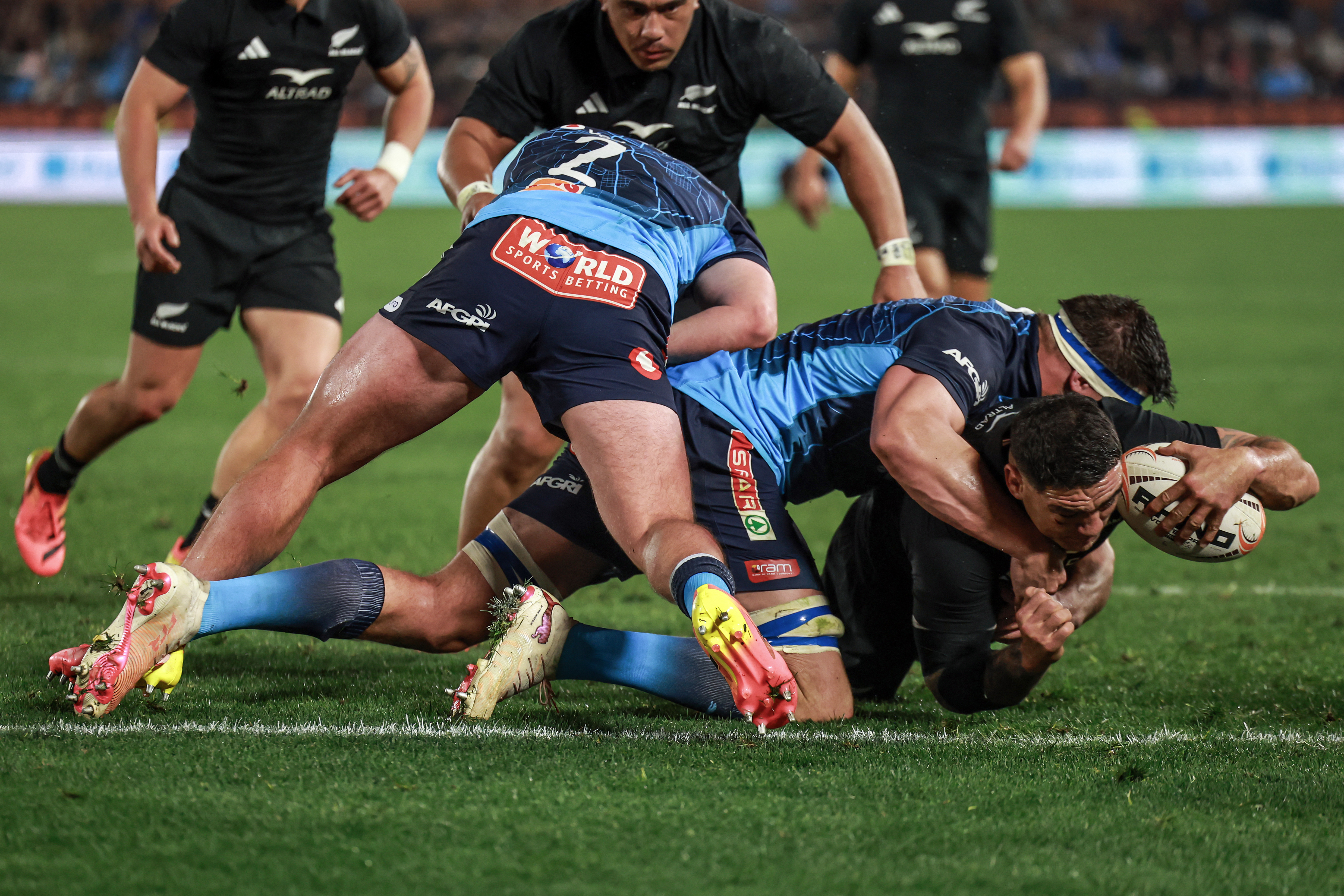
The All Blacks produced a statement performance at Ellis Park, overturning the pre-Test predictions to defeat South Africa 33–16 and take a 1–0 lead in the Rugby’s Greatest Rivalry series.
In a contest that lived up to the intensity of more than a century of rivalry between the two nations, New Zealand showed remarkable composure under pressure, combining defensive resilience, clinical finishing and superior ball retention to claim one of their most impressive victories in recent history.
South Africa appeared to have the early advantage, using their trademark physicality to put the All Blacks scrum under immense pressure. The Springboks controlled much of the opening exchanges and spent long periods playing inside New Zealand territory.
ALSO READ: South Africa vs New Zealand: Siya Kolisi misses out as Springboks name squad to face All Blacks

However, the All Blacks absorbed the pressure without allowing it to translate into a decisive points advantage.
New Zealand finished the match with just 39 percent territory but enjoyed 56 percent possession and forced 14 turnovers compared to South Africa’s five. Their ability to protect possession and punish mistakes ultimately proved decisive.
Cheslin Kolbe opened the scoring with a fourth-minute penalty, but the All Blacks quickly demonstrated that they were prepared to attack whenever opportunities presented themselves.
After winning a lineout inside the Springboks’ 22-metre area, New Zealand launched a driving maul before halfback Cam Roigard moved the ball away from the breakdown. His long pass created the opening for Will Jordan, who finished clinically in the corner.
South Africa responded almost immediately. A well-worked lineout move released Andre Esterhuizen, who broke through Josh Moorby’s tackle before crossing the whitewash in the 13th minute.
The All Blacks continued to threaten from broken play. Jordie Barrett was heavily involved in their attacking patterns, while Tupou Vaa’i produced a superb piece of skill to release Moorby, who beat a tackle and raced in for New Zealand’s second try after 22 minutes.
Ruben Love converted from the touchline to put the All Blacks ahead, although Kolbe added another penalty soon after to keep the Springboks within touching distance.
South Africa had opportunities to extend their advantage but failed to convert them. Malcolm Marx came agonisingly close to scoring after breaking through the All Blacks’ defence, only for Jordie Barrett to get a hand to the ball and force the Springbok hooker to lose control as he attempted to ground it.
That defensive intervention summed up New Zealand’s performance: relentless under pressure and unwilling to concede easy points.
South Africa led 13–12 at halftime, but the complexion of the contest changed dramatically early in the second half.
The Springboks continued to rely on their kicking game and physical carries, but the All Blacks began to turn defensive pressure into attacking opportunities.
A pivotal moment arrived in the 47th minute when Fabian Holland charged down a clearing kick from Grant Williams. The lock recovered the ball, stepped Sacha Feinberg-Mngomezulu and raced over for a crucial try.
It was the score that shifted momentum firmly in New Zealand’s favour.

The introduction of Fletcher Newell and Asafo Aumua also gave the All Blacks fresh impetus at the set-piece. After absorbing heavy scrum pressure in the opening half, New Zealand’s replacements helped stabilise the scrum and put the Springboks under renewed pressure.
From there, the All Blacks began to take control.
New Zealand’s defence was arguably the foundation of their victory.
The All Blacks made 132 tackles compared with South Africa’s 86, repeatedly denying the hosts clean attacking platforms. Their line speed and scramble defence frustrated the Springboks, particularly when South Africa attempted to stretch the defence with cross-field kicks and wide passes.
The Springboks also struggled with decision-making in key moments. One cross-field kick from Feinberg-Mngomezulu went directly into touch when retaining possession could have offered South Africa a better attacking opportunity.
New Zealand, by contrast, were clinical whenever South Africa presented an opening.
Will Jordan added his second try as the All Blacks continued to exploit space, while their ability to win turnovers and recycle possession kept the Springboks on the back foot.
South Africa’s frustration eventually boiled over in the closing stages, with two yellow cards leaving them short-handed during the final 10 minutes.
The All Blacks capitalised ruthlessly, closing out the contest with confidence to secure a commanding 33–16 victory.
The result was more than just a victory. It was a demonstration of how New Zealand could withstand South Africa’s famed power game and still dictate the contest through tactical discipline, ball security and attacking efficiency.
The Springboks dominated phases of the match, particularly through their carries, scrum pressure and lineout platform, but the All Blacks were better at turning their opportunities into points.
Five tries to one ultimately told the story.

New Zealand now lead the Rugby’s Greatest Rivalry series 1–0, with the victory providing a major psychological boost after arriving at Ellis Park as underdogs.
For South Africa, the defeat will raise questions over their execution, discipline and decision-making. For the All Blacks, however, it was a night that showcased resilience, tactical intelligence and the ability to thrive in one of rugby’s most intimidating environments.
At Ellis Park, New Zealand did not simply survive the Springbok pressure. They absorbed it, waited for their moments and then struck with devastating precision.
[…] ALSO READ: How the All Blacks outclassed the Springboks in the first test […]
[…] ALSO READ: How the All Blacks outclassed the Springboks in the first test […]
[…] ALSO READ:How the All Blacks outclassed the Springboks in the first test […]
[…] ALSO READ: How the All Blacks outclassed the Springboks in the first test […]
[…] ALSO READ: How the All Blacks outclassed the Springboks in the first test […]