
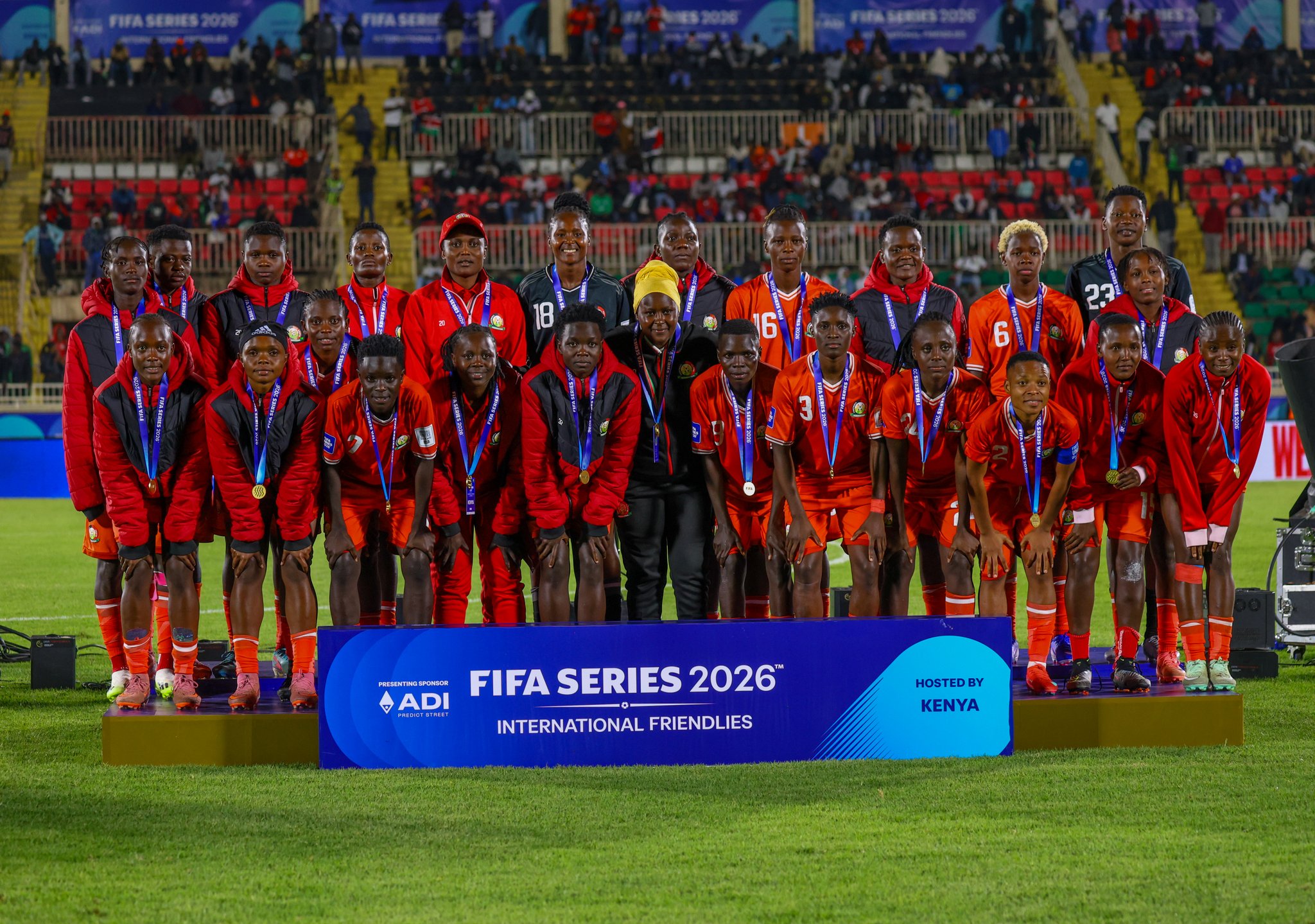
As the dust settles at the Nyayo National Stadium in Nairobi, Kenya following the conclusion of the first-ever women’s FIFA Series 2026, the conversation has shifted from the results to the future of the women’s game in Kenya.
The four-nation tournament provided a rare litmus test for the Harambee Starlets, offering crucial insights into what is required to bridge the gap between African football and the world stage.
Tactical discipline
For years, African teams were often described as physically strong but tactically raw.
In this tournament, the Starlets proved the first half of that statement is true, but in a positive way.
Against India, the Starlets used their explosive speed to win 50/50 balls and track back. They didn’t get bullied off the ball easily.
Tactical discipline is however more or less about transitions, the split second when a team moves from attacking to defending. This is where the Matildas showed their class.
While a Kenyan player might focus on the person with the ball, Australian players were constantly moving into pockets of space. This ghost running forced the Kenyan midfielders to move out of position to cover them.
When Kenya’s midfield was pulled out of its structure to chase the ball, Australia immediately exploited the holes left behind and could be perfectly evidenced by the second goal scored by Clare Wheeler.
Facing the Matildas of Australia and India’s Blue Tigresses highlighted a need for better positional transitions.
To improve our FIFA ranking, the Starlets need more of this inter-confederation exposure, playing against different football languages to build the composure required for the world stage.
ALSO READ: Kenyan scout Naythan Din-Kariuki earns global recognition alongside Arsenal star Eberechi Eze
Security and Stewards
Perhaps the most refreshing takeaway for regular stadium-goers was the conduct of the match-day stewards.
Unlike the tension and frequent confrontations often witnessed between fans and security, the stewards at the FIFA Women’s Series were organized, professional and firm yet approachable.
Their ability to manage the crowd without escalating friction ensured a family-friendly atmosphere throughout the tournament.

Professional media relations
A significant factor behind the heavy presence of journalists, reporters, and videographers was the seamless media structure provided by the organizers.
From the well-timed Match Day -1 (MD-1) press conferences and open training sessions to the match-day logistics, the experience was world-class.
Professionals benefited from a reserved press tribune, a functional mixed zone for quick player interviews, and prompt post-match press conferences.
Sound technicalities mar entertainment
A major talking point throughout the tournament was the disconnect between the star power on stage and the technical delivery.
On the opening day, Femi One’s high-energy performance was stifled by a lackluster sound system that failed to carry her vocals across the stands. The trend continued into the second day, where Iyanii’s set was plagued by similar audio issues.
When merging sports and entertainment, the show is just as important as the game.
For a FIFA-standard event, failing on basic sound system does a disservice to the artists and the fans. Future organizers must invest in high-quality systems to match the caliber of the performers.
The rise of digital media
The tournament underscored a massive shift in the Kenyan media landscape with the unstoppable rise of digital sports media.
A significant portion of the accredited personnel were not from traditional TV or print houses but were independent digital creators and freelance journalists.
Armed with nothing more than high-end smartphones and a data connection, these creators flooded platforms with reels, photos and behind-the-scenes clips.
The viral nature of this content, specifically surrounding global icons like Chelsea’s Sam Kerr and Arsenal’s Caitlin Foord generated a level of online engagement that traditional media alone could not achieve.
Instead of seeing digital creators as unauthorized competition for broadcast rights, Kenyan football can benefit with them on board.
The Gen Z surge in national team events.
Recent attendance figures for the Safari Sevens, HSBC Sevens 2, CHAN 2024, and now the FIFA Women’s Series confirm one thing – Kenyan Gen Z has fully embraced the national teams.
For this demographic, the stadium has become a hub for fashion, content creation, and the vibes.
However, a glaring gap remains between the massive crowds seen at these international showpieces and the more modest turnouts for domestic fixtures.
The big question now is how to convert the energy seen at Nyayo Stadium into consistent support for the SportPesa League and the Kenya Cup in rugby.
ALSO READ: Life of second chances – The rise, the fall and rise again of Kenyan international Frank Odhiambo
The post-tournament hangover – A crisis in the KWPL
The FIFA Women’s Series was a spectacle of hype, high-end branding and international flair.
But as the Matildas fly out and the FIFA banners come down, the spotlight returns to a sobering reality for the Kenya Women’s Premier League (KWPL).
While the national team shone on the global stage, the domestic engine that feeds it is stalling. T
he KWPL currently operates without a title sponsor or a broadcast partner, leaving clubs to survive on shoestring budgets.
The situation reached a breaking point recently, with 7 out of 12 teams boycotting league fixtures over financial and administrative grievances. Compounding the crisis is the cancellation of the FKF Women’s Cup.
All these point out to the reality that we still need to do more for the girls outside the hype during major competitions.
We should ask ourselves what difference does the series bring to our nation and how best to build from it heading into the country’s participation at the in the women’s Africa Cup of Nations in July in Morocco.
The FIFA Women’s Series was a reality check wrapped in an opportunity. Kenya has the fans, the digital talent, and the logistical capability to be a global hub for sports.
However, for this to be more than just a one-off hype, the professionalism seen at Nyayo Stadium must become the daily standard for our local leagues.
We have the blueprint, now we need the political and corporate will to build the house as we prepare for hosting the Afcon in 2027.